
What does AI really cost? Not in terms of subscription models or API prices, but in terms of electricity consumption, CO₂ emissions, and water usage.
We wanted to explore this question by doing what we do best: designing and developing applications. The idea: an LLM Sustainability Calculator that makes the environmental impact of using large language models more tangible.
After all, AI often seems intangible in everyday life: a prompt, a response, a few seconds of waiting. But behind it all lies real infrastructure: data centers, servers, chips, power supplies, and cooling systems.
The Idea: Making Environmental Impacts Easier to Understand
The basic idea behind the app was simple: Users enter a number of tokens, select an AI model, and then receive an estimate of three environmental metrics:
- CO₂ emissions
- Water Consumption
- Electricity consumption
In addition, the calculator translates these values into easy-to-understand, everyday comparisons. For example: How many times could you charge a smartphone with that? How long could an LED light stay on? How far could a car travel?
This makes abstract numbers more tangible.
The Prototype: An App for Navigation
That idea led to the creation of an initial prototype: the LLM Sustainability Calculator.
The app makes the environmental impact of using LLMs visually tangible. After entering the number of tokens and the model, the app shows the approximate impact a query might have: CO₂ emissions, water consumption, and electricity consumption.
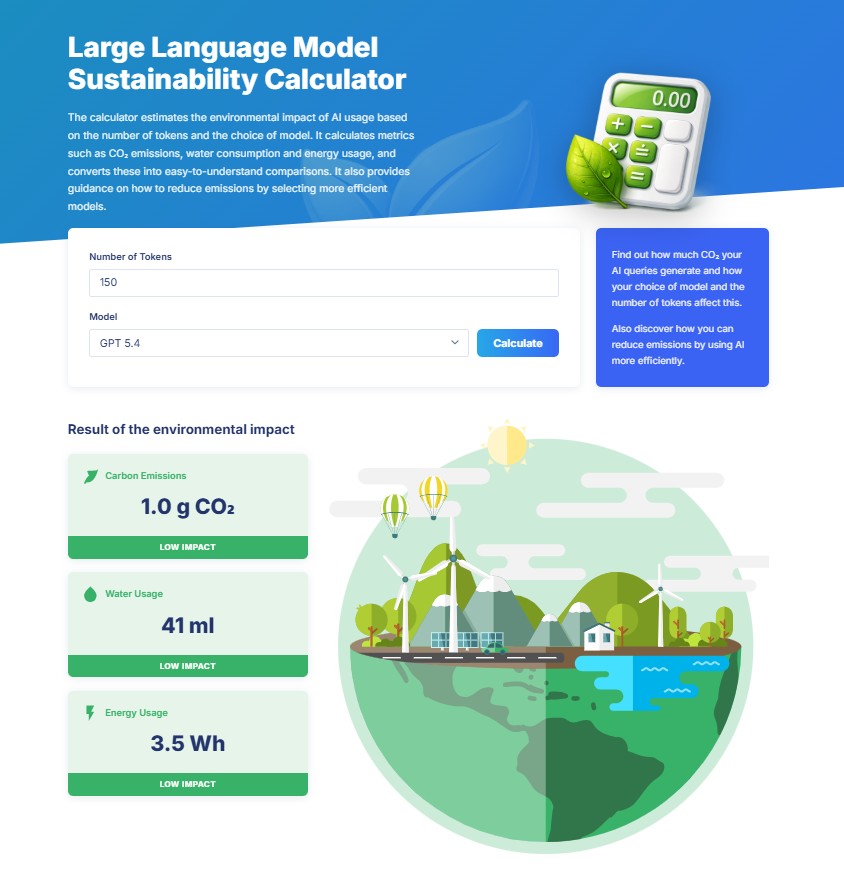
To help users quickly interpret the results, the app uses a simple traffic-light system: green indicates a low impact, yellow a moderate impact, and red a high impact. This makes it clear at a glance whether a query has a relatively minor impact or whether the model selection and token count have a significantly greater influence.
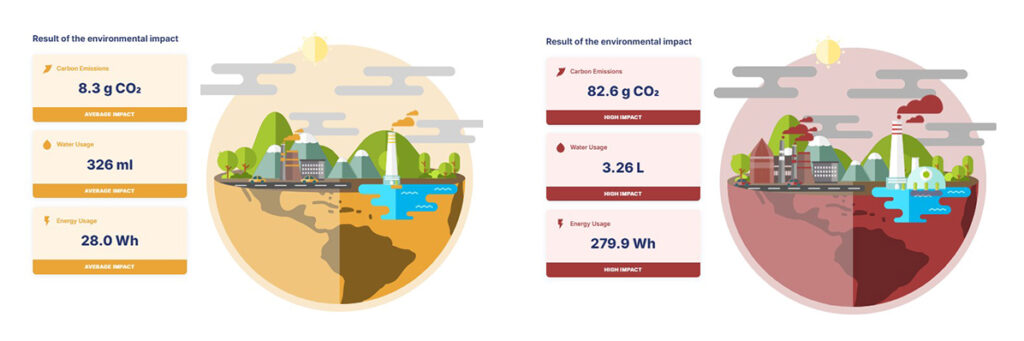
In addition, the app translates the figures into everyday comparisons: smartphone charges, LED burn times, car mileage, or Google searches. This makes abstract figures like grams of CO₂ or watt-hours easier to understand.
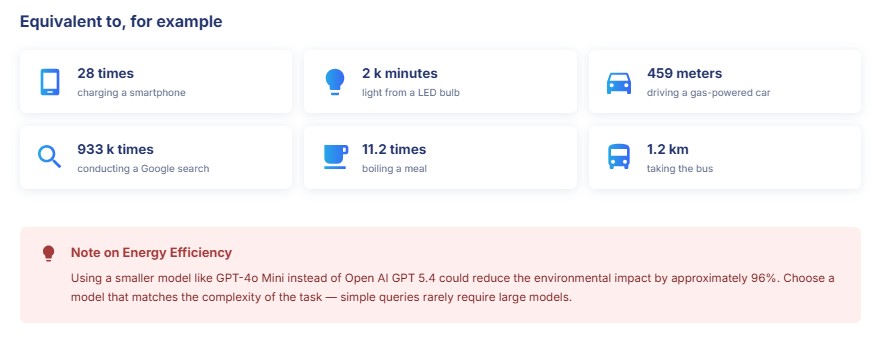
The design of the results graphic also follows this concept: The visual tone of the illustration changes depending on the calculated impact—ranging from green and clean to red and polluted. The calculator thus conveys the sense that AI usage is not invisible, but rather relies on real-world infrastructure: electricity, water, cooling, servers, and data centers.
An additional information section shows which data sources, assumptions, and calculation steps underlie the results.
The main hurdle: a lack of transparency regarding new models
As we worked on this, it quickly became clear that a rough estimate is possible. However, a truly reliable calculation fails not only because individual values are inaccurate. The bigger problem is that key information is no longer published for many new models.
Model size would be particularly important. The number of parameters has a major impact on fuel consumption, but this information is often no longer disclosed for current models. This means there is no decisive basis for meaningfully comparing different models.
In addition, there are other factors that are usually not visible to users:
- Which model was used?
- How many tokens were processed or issued?
- How many parameters does the model have?
- How long does the inference take?
- In which data center was the request processed?
- What is the energy mix used there?
- How is the data center cooled?
A request to an LLM is processed somewhere, but most of the time you don’t know in which data center, in which country, or using what energy mix. The exact number of output tokens isn’t always displayed either, depending on the interface. Especially with applications like inline code completion, it is difficult to determine how much was actually generated.
This isn’t just a matter of “a little inaccuracy.” Fundamental data necessary for a reliable calculation is missing.
Why We Didn’t Release the App
In the end, we were faced with an important decision: Should we release a calculator that provides guidance but has to rely on assumptions in key areas? Or should we refrain from doing so because the results might appear more accurate than they actually are?
We decided against releasing it as a calculator.
The reason: Values such as “6.9 grams of CO₂” or “272 milliliters of water” appear very precise. However, if these figures are based not only on minor inaccuracies but also on a lack of basic data, a false sense of precision can quickly arise.
That would be particularly problematic when it comes to sustainability. After all, it’s not just about presenting numbers; it’s about interpreting them responsibly.
What We’ve Learned from This Work
Even though the computer wasn’t released in the end, the work that went into it was very valuable.
It was only through the combination of app development, research, and data analysis that the true complexity of the topic became apparent. At first glance, the idea seems simple: enter tokens, select a model, calculate consumption. In practice, however, the result depends on many factors that users are usually unaware of and that providers often do not fully disclose.
One thing became particularly clear: A well-designed interface can help users navigate the information, but it is no substitute for a reliable data foundation. Even figures published by individual providers are difficult to compare because they are collected using different methods and can quickly become outdated.
The most important finding, therefore, was not a single number, but a better understanding of the level of transparency needed to classify AI emissions in a truly reliable way.
What Users Can Still Do
Even though it is currently difficult to calculate the exact resource consumption of individual requests, there are useful guidelines.
For simple tasks, a smaller model is often sufficient. Not every summary, rephrasing, or quick search requires the most powerful model available.
For complex tasks, a large model can be useful. But even then, it’s worth using it thoughtfully: large models for difficult thinking and planning tasks, and smaller models for simpler implementation steps.
Precise prompts also help. If you ask questions more clearly, you’ll have to make fewer revisions. Fewer unnecessary iterations also mean less computational effort.
AI-powered software development, in particular, involves yet another consideration: It’s not just the use of the model that consumes resources. The generated code may also run efficiently or inefficiently later on. It may therefore be advisable to explicitly instruct AI tools to prioritize efficient implementation, short runtime, and resource-efficient solutions.
Conclusion
In the end, our LLM Sustainability Calculator was not released as an app.
Not because the environmental costs of AI are unimportant, but because they currently cannot be reliably calculated without key data from the providers.
From our perspective, this means we need greater transparency directly from the providers: How much energy, CO₂, and water does using a model for inference consume? What methodology is used to calculate these values? And how can they be compared with other models?
Only when such information is available in an open and transparent manner can AI models be evaluated not only on the basis of quality, speed, and price, but also on the basis of their environmental impact.
Until then, any external calculation remains an approximation. That is precisely why we have decided not to publish seemingly exact values, but rather to clearly state the limitations of such calculations.
We wanted to calculate AI emissions, and in the process, we learned exactly why that is still so difficult.