TL;DR:
A Quick Summary: The Most Important Facts About the Zephyr Project
Zephyr is an open-source real-time operating system (RTOS) developed specifically for embedded systems. It is managed by the Linux Foundation and distributed under the Apache 2.0 license, making it freely available and suitable for commercial use.
Key Features of Zephyr
- Modular and scalable: Adaptable to various hardware platforms
- Low resource consumption: Runs on devices with just a few KB of RAM and flash memory
- Real-time capable: Fast and deterministic response times
- Security features: Secure boot, memory protection, regular updates
- Broad hardware support: From IoT sensors to industrial equipment
Applications
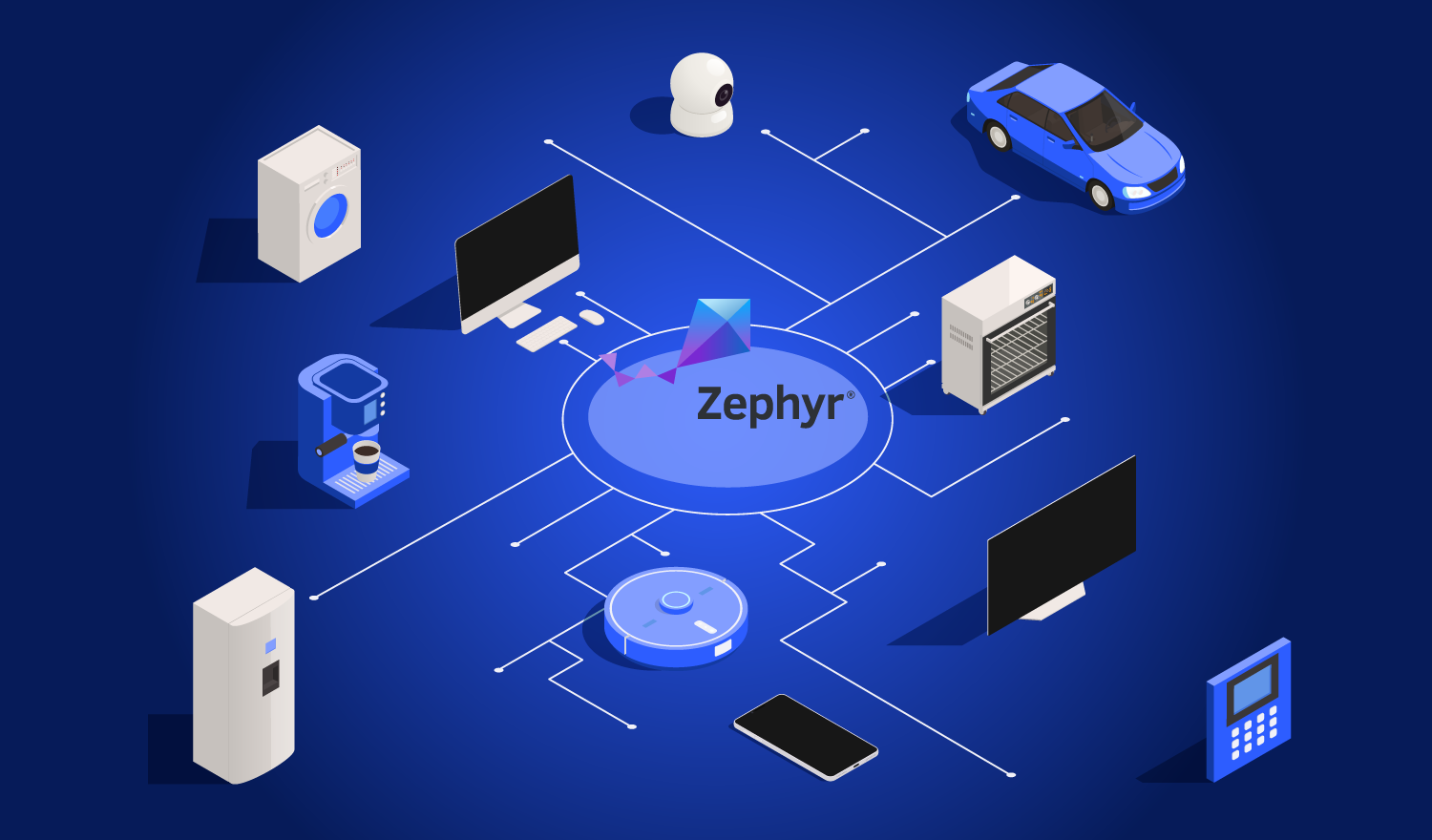
- IoT and smart devices: Sensors, connected home appliances, edge computing
- Wearables: Smartwatches, fitness trackers, medical devices
- Industry 4.0: Machine control, connected production facilities, sensor networks
- Automotive industry: Control units, driver assistance systems, V2X communication
Limitations of Zephyr
- Less suitable for complex GUIs: No native graphics support; however, LVGL provides a GUI stack that is perfectly adequate for GUIs of low to medium complexity.
- Limited multimedia streaming capabilities: Only basic video/audio processing
- Not suitable for performance-intensive applications: Zephyr is optimized and designed for small controller systems intended to perform measurement and control tasks.
Alternatives
- FreeRTOS: A minimalist RTOS for microcontrollers
- VxWorks / QNX: Real-time operating systems for the automotive and industrial sectors.
- Yocto / Embedded Linux: For more powerful systems with a GUI and network connectivity
Get to Know and Understand Zephyr
Learn more about our Zephyr Basic Training
Learn more about our Zephyr Advanced Training
In the world of embedded systems, efficiency, scalability, and security are crucial. This is exactly where Zephyr comes in: an open-source real-time operating system that is rapidly establishing itself as the standard for the Internet of Things (IoT), wearables, and industrial applications. Its modular architecture enables broad hardware support with minimal resource consumption—a key advantage for software developers, engineers, and product managers who want to build powerful and reliable embedded systems.
A Brief Explanation — What Is Zephyr?
Zephyr is a flexible, open-source real-time operating system (RTOS) designed specifically for embedded systems with limited resources. The Zephyr project is managed by the Linux Foundation and supports a wide range of microcontrollers and architectures.
Zephyr stands out with a range of features that make it an attractive choice for embedded developers. Thanks to its modular and scalable architecture, it can be flexibly adapted to different hardware platforms and use cases. Its low memory requirements allow it to be used even on devices with only a few kilobytes of RAM and flash memory.
As a real-time operating system, Zephyr offers deterministic behavior, making it ideal for time-critical applications. Built-in security mechanisms enhance system security and make it resilient to threats. Additionally, Zephyr is platform-independent and supports a wide range of architectures, including ARM, x86, and RISC-V.
As an open-source project licensed under the Apache 2.0 License, the source code is freely available, which fosters an active community and continuous development. Zephyr is particularly well-suited for IoT devices, wearables, industrial control systems, and medical applications.
Basic Requirements for an RTOS (Real-Time Operating System)
To be suitable for time-critical applications, a real-time operating system (RTOS) must meet certain fundamental requirements that make it the ideal choice for industrial controls, IoT devices, automation systems, and safety-critical applications. These include:
Predictable Timing Behavior
Zephyr is characterized by predictable timing behavior, which is crucial for real-time applications. Thanks to deterministic response times, the system can reliably process events within specified time limits. A real-time-capable scheduler supports both hard and soft real-time requirements, allowing developers to choose the optimal strategy depending on the use case. Additionally, Zephyr ensures low latency by responding quickly to interrupts and switching between tasks efficiently—a key advantage for time-critical applications.
Support for Measurement and Control Tasks
Zephyr offers comprehensive support for measurement and control tasks, which are fundamental to many embedded applications. Precise timing functions enable the use of timers and timestamps for accurate measurements. The operating system efficiently processes sensor data and reliably controls actuators, making it ideal for IoT and industrial applications. In addition, powerful interrupt handling ensures that external events are prioritized and processed without delay—a key requirement for reactive and time-critical systems.
Support for Various Hardware Platforms
Zephyr is a platform-independent real-time operating system that supports a wide range of hardware architectures, such as ARM, x86, and RISC-V. Thanks to its high scalability, it can be used efficiently on both high-performance systems and resource-constrained microcontrollers. Another advantage is its comprehensive driver support, which simplifies the integration of new hardware and peripheral devices. This allows developers to flexibly adapt Zephyr to various applications without having to commit to a specific platform.
Efficient Resource Management
Zephyr is characterized by efficient resource management that is specifically optimized for embedded and IoT applications. Thanks to its low memory requirements, it runs reliably even on devices with minimal RAM and flash memory. Its built-in multitasking capability allows multiple threads to run simultaneously, ensuring that applications remain responsive and high-performing. In addition, optimized power and CPU management ensures energy-efficient operation—a crucial advantage for mobile and battery-powered devices.
Security and Reliability
Zephyr prioritizes high security and reliability to ensure stable and robust embedded systems. Memory protection mechanisms isolate critical processes and prevent unintended interference, thereby enhancing system stability. Thanks to built-in fault tolerance, Zephyr detects and handles potential errors early on to minimize outages. In addition, real-time synchronization mechanisms such as mutexes, semaphores, and message queues ensure smooth and secure communication between an application’s threads.
Communication Capabilities
Zephyr offers comprehensive communication features that enable seamless networking and efficient data transmission. It supports numerous network protocols, such as Ethernet, Wi-Fi, Bluetooth, MQTT, and CAN, allowing the system to be flexibly integrated into various IoT and industrial applications. Zephyr ensures smooth interprocess communication (IPC) with efficient mechanisms for data transfer between an application’s threads. Furthermore, the prioritized processing of real-time data guarantees reliable and low-latency communication—essential for time-critical applications.
Where is the Zephyr operating system used?
The Zephyr real-time operating system (RTOS) is used in various fields, particularly where limited resources, real-time capability, and scalability are required. It was developed specifically for embedded systems and offers a powerful, flexible, and secure platform for applications with high demands on efficiency and reliability.
As an open-source project, Zephyr benefits from an active developer community that continuously provides new features and security updates. With support for many architectures and microcontrollers, it is cross-platform and facilitates the development of portable software solutions. These features make Zephyr a future-proof choice for embedded systems in certain fields.
IoT Devices
The Internet of Things (IoT) requires operating systems that can run on small, energy-efficient, and connected devices. Zephyr was developed specifically to meet these requirements and offers a resource-efficient, secure, and scalable platform for IoT applications.
Thanks to its modular design, developers can include only the components they need to minimize memory usage. At the same time, Zephyr offers broad support for network protocols and wireless communication standards, allowing devices to be seamlessly integrated into existing IoT ecosystems.
Applications
- Smart sensors for industry, smart homes, and environmental monitoring
- Connected home appliances, such as smart thermostats, lighting controls, or connected coffee makers
- Edge computing devices that process sensor data locally to reduce network traffic and latency
Wearable Devices
Wearable devices require a lightweight, energy-efficient, and highly customizable operating system. Zephyr meets these requirements through its low resource consumption, real-time capabilities, and flexible hardware support.
Many wearables feature sensors for collecting health and activity data, which must be processed in real time. Zephyr offers a deterministic scheduler architecture for this purpose, enabling fast and reliable response times. It also supports a wide range of communication protocols, allowing wearables to connect wirelessly to smartphones or cloud services.
Applications
- Health trackers that measure vital signs such as heart rate, blood oxygen levels, or sleep patterns
- Smartwatches that offer both fitness and communication features
- Hearing aids that process audio data in real time and communicate wirelessly with other devices
- Medical devices, such as portable blood glucose monitors or smart insulin pumps
Industrial Control Systems
In industrial automation, reliability, real-time performance, and scalability are critical. Production facilities, machine controls, and sensor networks must operate deterministically and with low latency to precisely control and efficiently optimize processes. Zephyr is ideal for this purpose, as it is a lightweight yet powerful real-time operating system that runs on various industrial hardware platforms and offers a high degree of adaptability to specific requirements.
By supporting industrial communication protocols such as CAN, Modbus, and Ethernet, Zephyr can be seamlessly integrated into existing Industry 4.0 systems. It also enables secure and reliable networking of machines, sensors, and edge devices to analyze data in real time and optimize processes.
Applications
- Machine control for robotic arms, production lines, or CNC machines
- IoT-enabled production systems that collect data and automatically forward it to a central control system
- Sensor networks that monitor production conditions such as temperature, vibrations, or humidity in real time
- Industrial edge computing, in which data is processed directly at the machine to reduce latency
Automotive Industry
In modern vehicles, embedded systems are essential for safety, connectivity, and automation. Zephyr offers a powerful real-time platform for automotive applications that require fast sensor data processing, secure communication, and deterministic behavior.
With the increasing adoption of vehicle-to-everything (V2X) connectivity, advanced driver-assistance systems (ADAS), and autonomous driving, the demand for reliable, secure, and efficient operating systems is growing. Zephyr can be deployed on various microcontrollers and control units within the vehicle and supports real-time communication, cybersecurity, and energy efficiency to meet the requirements of modern vehicle systems.
Applications
- Control units for sensors in advanced driver-assistance systems (e.g., cameras, radar, lidar, ultrasonic sensors)
- V2X (Vehicle-to-Everything) communication for connecting vehicles to each other and to infrastructure
- Telemetry systems that collect and transmit vehicle data—such as speed, engine diagnostics, or GPS positions—in real time
- Battery management systems (BMS) in electric vehicles for monitoring and optimizing battery performance
Zephyr Essentials Training
The hands-on basic course for the Zephyr real-time operating system – with a focus on the practical application of the framework.
The Zephyr System Offers You These Benefits
The powerful and versatile Zephyr real-time operating system (RTOS) offers numerous beneficial features that make it particularly attractive for embedded systems, IoT, and real-time applications.
1. Low resource consumption
Zephyr requires only a few kilobytes of RAM and flash memory, making it ideal for microcontrollers and IoT devices with limited resources.
2. Modularity
The system has a highly modular design, allowing developers to integrate only the components they need. This keeps it lean and adaptable for various applications.
3. Real-time capabilities
Zephyr offers a deterministic, low-latency task-scheduling architecture, making it suitable for time-critical applications such as industrial controls or wearables.
4. Platform Independence
It supports numerous architectures (ARM, x86, RISC-V, etc.) and a wide range of microcontrollers and development boards, offering developers a high degree of flexibility.
5. Security
Zephyr features built-in security mechanisms, including memory protection, secure boot processes, and regular security updates, to safeguard critical applications.
6. Open-Source Project
Zephyr is freely available under the Apache 2.0 license, which means developers can use it at no licensing cost and it is continuously improved by a large open-source community.
7. Broad Hardware and Driver Support
Thanks to a large and ever-growing library of drivers, numerous sensors, interfaces, and communication protocols can be easily integrated.
8. Energy Efficiency
Zephyr supports powerful energy management features, making it ideal for battery-powered IoT devices and wearables.
9. Scalability and Customizability
It is suitable for both small embedded systems and complex industrial applications, as it is flexibly configurable.
In which areas does Zephyr reach its limits?
Zephyr is ideal for embedded systems with limited resources and real-time requirements, but it reaches its technical and functional limits in certain areas—for example, with graphics-intensive applications, high-performance computing, multimedia streaming, or user interactions. Linux, Android, or specialized RTOS solutions are better suited for these use cases.
Complex User Interfaces (GUI Applications)
Zephyr is specifically optimized for resource-constrained embedded systems and therefore does not offer native support for graphics-intensive user interfaces. Advanced GUI frameworks such as Qt or GTK cannot be used directly, which makes developing complex graphical interfaces more difficult. However, a port of Qt to Zephyr is scheduled for 2025.
This makes Zephyr less suitable for devices such as smartphones, tablets, or infotainment systems that rely on high-performance visualizations and touch input. Instead, the focus is on lean, efficient systems that operate with minimal resources.
High Resource Requirements (High-Performance Computing)
Zephyr was developed specifically for small microcontrollers with limited RAM and flash memory and is not designed for computationally intensive applications. Although Zephyr supports high-performance application processors and is, in principle, multicore-capable, it is still not suitable for computationally intensive tasks.
As a result, Zephyr is not an ideal choice for applications that require significant computing power, such as neural networks, big data processing, or complex scientific calculations. Instead, the focus is on efficiency and minimal resource consumption in embedded and IoT systems.
Multimedia Streaming and Real-Time Video Processing
Zephyr is not designed for multimedia applications, as it does not offer specialized support for video and audio processing. Features such as hardware acceleration for graphics, video, or audio encoding are missing, which limits its use in this area.
Therefore, Zephyr is not suitable for streaming platforms, smart TVs, or high-resolution camera systems that require powerful media processing. Instead, the focus is on resource-efficient embedded applications without high multimedia requirements.
Applications with Real-Time Databases and Cloud Services
Zephyr communicates using network technologies such as MQTT or CoAP, but does not offer native support for large databases or direct cloud connectivity. Features for relational or NoSQL databases are not integrated, making it difficult to store and manage large amounts of data.
Therefore, Zephyr is not the best choice for database servers, extensive cloud backends, or big data analytics. Instead, it is well-suited for lean, networked systems that require minimal memory and computing resources.
Operating Systems for General-Purpose Applications
Zephyr was developed as a real-time operating system for embedded systems and is not designed for general-purpose computing applications or office software. It offers neither multi-user support nor a desktop environment, which limits its use in traditional IT systems.
Therefore, Zephyr is not a suitable solution for PCs, laptops, or standard server applications. Instead, it focuses on lean, specialized embedded and IoT systems with real-time requirements.
Zephyr Advanced Training
This practice-oriented workshop for advanced users serves to deepen Zephyr knowledge.Other Alternatives
There are several alternatives to Zephyr, some of which may be better suited depending on the use case. Choosing the best alternative depends on the application, resource requirements, and real-time or safety requirements.
Here are some of the most important alternatives:
1. FreeRTOS — An Alternative for Resource-Constrained Real-Time Applications
FreeRTOS is a lightweight, open-source real-time operating system that is particularly widespread in IoT and embedded systems. It is considered one of the best alternatives for microcontrollers with limited resources and is ideal for simple, compact applications.
FreeRTOS requires only minimal memory and runs even on microcontrollers with just a few kilobytes of RAM. It supports numerous architectures such as ARM, RISC-V, and x86, offering a high degree of flexibility. It also benefits from a large developer community and is directly integrated with AWS IoT, making it easier to use in cloud-based applications.
Limitations: Unlike Zephyr, FreeRTOS does not offer built-in network interfaces—these must be added via external libraries. It also has fewer built-in security features, which may require additional protective measures. The device tree technology is a key differentiator for Zephyr in the RTOS market. Without a device tree, for example, porting an application from one hardware platform to another becomes significantly more difficult and time-consuming.
2. RTEMS – An Alternative for Safety-Critical Applications
RTEMS (Real-Time Executive for Multiprocessor Systems) is an open-source real-time operating system developed specifically for industrial and aerospace applications. It is used by organizations such as NASA and ESA and is particularly well-suited for systems with high safety requirements.
RTEMS is certified to strict safety-critical standards such as DO-178B for the aerospace industry, making it ideal for mission-critical applications. In addition, it supports multiprocessor systems and offers high reliability, which is why it is frequently used in space and automation projects.
Limitations: RTEMS is less flexible for small IoT devices, as it is not optimized for minimal resource consumption. Furthermore, its configuration is more complex than that of Zephyr or FreeRTOS, making it more challenging for developers to learn.
3. VxWorks — An Alternative for Industrial and Commercial Real-Time Applications
VxWorks is a proprietary real-time operating system from Wind River that is widely used in industry. It is frequently employed in fields such as robotics, automotive, aerospace, and medical technology, and offers reliable real-time capabilities for demanding applications.
Thanks to its hard real-time capabilities, VxWorks is ideally suited for time-critical systems. It also offers comprehensive safety and certification options that facilitate its use in aerospace and medical technology. Another advantage is its support for modern multicore processors, which enables the creation of powerful and scalable systems.
Limitations: Unlike open-source alternatives such as Zephyr or FreeRTOS, VxWorks is a paid product and requires a license. Additionally, customization options are limited because the source code is not freely available. This restricts flexibility when addressing specific development requirements.
4. QNX – An Alternative for Automotive and Safety-Critical Systems
QNX is a proprietary, microkernel-based real-time operating system from BlackBerry that is particularly widespread in the automotive industry. It is frequently used in safety-critical applications such as in-vehicle infotainment systems, control units, and medical technology.
QNX offers reliable real-time capabilities and is used in many modern vehicles for infotainment and control systems. It complies with numerous industrial and automotive standards, making it a safe choice for safety-critical applications. The microkernel architecture ensures high stability, as only essential system components run in the kernel, which reduces the risk of system failures.
Limitations: As a proprietary operating system, QNX is a paid product and is not open source, which limits customization options compared to open-source alternatives. Furthermore, it is not optimized for extremely resource-constrained microcontrollers but is rather designed for more powerful embedded systems.
5. Linux-based Alternatives (Yocto, Buildroot, Android Things) — For High-Performance Embedded Systems
Linux-based solutions such as Yocto, Buildroot, and Android Things offer a flexible alternative for more powerful embedded and IoT applications. They are based on the Linux kernel and are particularly well-suited for systems with networking and multimedia requirements.
Compared to traditional real-time operating systems, Linux-based alternatives offer better support for networking and memory-intensive applications. Thanks to integrated graphics and multimedia capabilities, they are ideal for smart TVs, infotainment systems, and edge computing. Furthermore, developers benefit from a large community and long-term support, which facilitates further development and maintenance.
Limitations: Although Linux is now real-time capable thanks to the PREEMPT_RT merge, it remains memory-intensive and is therefore unsuitable for many real-time applications. In addition, these systems have higher memory consumption, making them unsuitable for microcontrollers with only a few kilobytes of RAM. As a result, they are designed more for higher-performance embedded platforms.
6. TinyOS — An Alternative for Extremely Low-Power Sensor Networks
TinyOS is an open-source real-time operating system designed specifically for wireless sensor networks with extremely limited resources. It is ideal for energy-efficient IoT applications that rely on long-lasting, battery-powered sensors.
TinyOS is characterized by extremely low power consumption, making it perfectly suited for low-power sensor nodes in wireless networks. Its modular architecture is specifically optimized for IoT applications and enables efficient communication between sensors.
Limitations: Unlike traditional RTOSs, TinyOS does not support conventional threads but is based on an event-driven architecture. Additionally, hardware support is more limited compared to Zephyr, which may restrict the selection of compatible platforms.